Thursday, 6 December 2012

My last nigth with Chris


Another perfect sunset, silhouettes and a haze of dust across the sky, it felt like we were walking in a dream. I don’t know why that afternoon was so different, but for some unexplained reason Chris and I walked for a whole hour before we were asked for money, and in the second hour only two people had asked us. It was a relief and we both felt a sense of peace just in being left alone for once.

Our walk led us to the hospital, and we walked straight in without seeing a single guard. The hospital was quite small, though a little decrepit it was clean, we only saw one nurse the whole time we were there. I assumed that visiting hours were over, but it was early enough for the patients to still be awake. It was not like the hospital in Ghana, reeking of desperation and disorder, it was calm there and quiet. The corridors were lined with glass windows and we could stare right in to the bed rooms. We only saw two people who seemed to be in pretty bad shape, one hooked up to a drip and the other so thin it brought flashes of David Edem to mind. Most of the patients were Himba people; it was quite a sight to see them in their cow-skin and heavy steal adornments, their thick clay coating and their matted dread locks, lying on crisp white sheets in hard cold rooms. Many of the Himba people had pulled their sheets to the floor and were lying beside the bed, perhaps a soft mattress takes as much getting used to as the hard floor did for us?

Afterward Chris and I sat and had a beer and a piece of BBQ-ed steak. We talked about travel and love and our hopes and dreams. I really like Chris. He is gentle and sentimental, passionate and brave and has a thirst for knowledge and people that is almost child-like. Even though we had only spent a week together, we had become very close. Travelling does that. When you have no one else but each other to rely on, when no one else understands you except each other, when you have to trust that person to protect you and keep you safe. I was feeling sentimental and sad. I had a feeling that it was going to be my last night with Chris. We had achieved what we had gone north to do – to see the Himba people. Chris wanted to head further north still to the Epupa waterfall, I needed to move on and say goodbye to Namibia, I still had Victoria Falls and Ethiopia and only a month left of my whole trip. Chris and I hadn’t actually talked about going separate ways, and I had a lump so large in my throat thinking about it that I couldn’t bare to bring it up with him then.

A man approached us and asked us for money. We tried to explain to him that fifty people or more a day ask us for money and we couldn’t possible say yes to everyone. He said he understood what we were saying and sat beside us and told us that Africans, particularly the Himba people, think that all white people are rich and that is why they get angry when we don’t give them money. We had a half hour long conversation where I actually thought he understood our point of view. But then he asked us again for money and exasperated we got up and left him there.

The next morning I woke up to a phone call from my partner. She told me she had been out the night before and slept with someone. My heart was pounding and my hands were shaking, even though we had an overseas arrangement actually meant it was ok to do so. But I thought about what Colin had been saying about sex the night before, and I was thinking about all the people I had met in Africa who thought sex meant nothing – it was something that all animals do, humans included, like eating and sleeping. And then my heart quietened down and my hands were steady again. We’d been apart for three months at that stage, it was starting to feel like three years.

It was a bad start to my day. I had had a troubled sleep, not knowing if I would stay with Chris or leave him that day. Not knowing how I would get out of that town, not really knowing where I was going next. I was feeling the same deep sadness as when I left Jo’Burg, thinking I would never see the friends I had made there again, and now I was thinking I will probably never see Chris again either. It made me feel nauseous. Decision making has never, and will never, been my forte.

I watched Chris go through his regular morning rituals that I found so endearing. The first thing he always did when he wakes up was rip the curtains open and declare with glee “the sun is shining!” like it wasn’t shining the day before, or the day before that, or every morning since he’d arrived in Africa. When he has his first sip of Earl Grey tea he always smacks his lips together and sighs “ah! That’s good!” like he has never tasted tea before.

When I told Chris that I was leaving that day he went into the bathroom and stayed there for what seemed like an awfully long time. He later told me that he was crying in there.

He watched me packed my bags (and couldn’t believe that I didn’t fold any of my clothes). He walked me to the start of the highway so that I could hitch-hike east, in the direction of Victoria Falls. The sun was hot and I was fighting back tears. We hugged and took a couple of photos and then it was time for him to go and try and get his ride North. As he walked away I let a single tear free.

About twenty feet away he stopped and turned back around.

“Friends for life?” he called to me.

“Friends for life!” I called back.

Twenty more feet after that he turned back around and blew me a kiss. Then he kept walking and once again I was on my own.


Wednesday, 5 December 2012

A reality check in a dream


Fairly late the next afternoon, Chris and I were bouncing around on the back of a beat-up old Ute (Colin our guide was in the passenger seat in the cabin). A group of men had to push the stalling vehicle until finally it farted into action and we rattled along a dirt track heading into the Namibian scrubland, heading deep into the big blank patch on our map. Both of us were in jeans and t-shirts, our faces pink and raw from the unyielding sun, goofy grins from ear to ear, we could taste the promise of something awesome to come. We were both standing up holding on to the flimsy sides; I think we were too excited to sit.

The all-Himba passengers (except for the skeletal goat) were staring us down, but Chris barely seemed to notice. I tried to smile at them, I tried to show my’ friendly foreigner’ face but it was received with stone-cold stares. I gave up on the locals and absorbed the surroundings instead. Herds of cows were led past us, beaten on the back by the young boys driving them. We hadn’t seen any villages yet but random groups of Himba people scattered the sides of the dirt path waiting for rides in to town.

My trance on the world going by was cut short when I felt this warm tickle on my bare toes. The goat was peeing on me. The Himba passengers nudged each other and giggled. My eyes met those of the goat and I couldn’t be angry, it was so scraggy and malnourished, and looked like it had copped its fair share of beatings in its life time. I tried to wriggle my toes out of the way, gently as though I didn’t want to hurt its feelings. I owe that goat a favour, the warmth of its wee had melted the ice amongst the passengers and the women in the Ute started to talk to me. They didn’t speak a word of English but tried to teach me some of their language. “Omudwandu” they rubbed their skin, “omuyapa: they touched mine. When we passed a cow or another car they would say a word and I would dutifully repeat it back to them. And then one of the men stood up beside me and sang to me. The women chuckled and I blushed.

The car was spitting up billows of dust which seemed to make the sunset a deeper scarlet colour. Chris was holding on to the cabin and facing the setting sun he faded in to a silhouette, around him the first stars began to glitter. In amongst cleared scrubs sat little villages of half a dozen or so little stick huts, a camp fire and Himba people going about their lives. One by one the others jumped off at their little villages and waved us goodbye, until it was just Chris and I, anxious to reach our destination.

When we finally spluttered to a halt the sun had well and truly set. Jeckey’s uncle, the driver of the Ute, led Chris, Colin and I to a little hut set apart from the rest of the village. This hut seemed bigger than the others, it could easily fit five adults lying side-by-side, it was raised off the ground on wooden stilts made of tree branches, the walls were made of mud clay, the roof was corrugated iron and inside it was bare except for a blanket on the floor. This would be where we slept.

We were instructed to leave our bags in the hut and the uncle led us to three women who were perched on the ground in the centre of the other huts.

‘What do you want to ask us?’

Colin interpreted, in very broken English, what the women said. They sat in bored silence waiting for us to throw a barrage of questions at them. It was all a bit awkward, set up like an interview. Neither Chris nor I had any real questions for them. We were there to just be silent observers or friendly guests. We weren’t anthropologists or politicians, but I got the feeling that those sorts of white intruders were what they were used to. The women kept waiting for us to ask questions. I had none. Chris was better than I was at easing the awkwardness and asking the usual sorts of questions: What do you eat? What do you believe in? Why do you cover your bodies in clay? Despite the awkward atmosphere it was peaceful out there. Quiet. A soft blue light made everything clear, cast from a nearly full moon.

Finally, the women gave us permission to leave and we went back to our hut. We weren’t even offered water, and I was worried we were meant to bring our own.

In the hut Colin, Chris and I made sandwiches from the supplies we had brought with us. Colin gave us the answers to the questions I wouldn’t have dared ask the women. ‘Wife sharing’ what I call ‘trading in women’ is common practice. When a baby is born it doesn’t matter who the biological father is, the husband must take responsibility for it. He then tells us that wearing condoms is common practice – which I do not believe at all. And he contradicts himself by saying that men will never perform oral sex on a woman because a man’s semen stays inside her and you don’t want another man’s in your mouth. He talked a lot about sex, and very graphically.

Sick of the way he was talking about sex and horrified at the way women are regarded I changed the topic, “The women kept telling us how poor they are… yet they own hundreds of cows” I asked him what a single cow would sell for. N$5000 – N$7000 he tells us. “Per cow!” I am shocked! They are really sitting on that much money? I try to tell him that all of my money and possessions combined equal 2 cows. He did not believe me. “Honest!” I protested.

As soon as Chris left the hut to pee, Colin asked me to write down my contact details in Australia: “then through the bank you can transfer money to me”.

The next morning we woke up with the sun, Chris had barely slept anyway, the cold stone floor hurting his back. I am lucky enough to be able to sleep anywhere, anytime, probably the reason I can travel so much.

We left the hut to explore the surroundings. Already the villagers were awake, inside a large wooden pen milking the cows. We stood watching long enough for one woman to invite me in and she showed me how to milk a cow. I crouched down beside her and gave it a go… nothing came out, not a single drop. She laughed and showed me how to do it again. Chris, another woman and some children stood beside me watching. I tried again, and still no milk came out. How hard could it be to milk a damn cow? Pretty hard is seems.

Colin came to take us away from the women and the cows and over to the uncle, it was time to present him with the gifts that we brought. He sat on a directors chair drinking beer, even though it was only 7am. We handed him the bag of oranges, 10 kilos of maize, drum of oil, box of tea and two kilos of sugar. We had also brought sweets for the kids, which neither Chris nor I wanted to do, but Colin had insisted we should. The kids that had taken to following us around all politely waited while Chris handed them all two sweets each.

The uncle did not look happy with our gifts. “Where is the tobacco?” he asked Colin to ask us. We hadn’t gotten any tobacco. A very young child, of maybe two or three was leaning between his knees and he gave the child the beer in his hand and shooed him away. The child happily held the 700ml bottle of beer that was half of the size of him and guzzled its contents. Chris and I flashed each other looks of disapproval but said nothing. Then the uncle opened the bag of sugar and filled the children’s cupped hands with it. The children shovelled the handfuls of white sugar into their mouths, and again Chris and I shared looks of reproach.

The women brought over bowls of sour milk for us. I gagged as soon as I saw it. I thought ‘no way can I drink that’. Chris went first. When he took a sip there were curdled chunks of milk on his lips and I had to get up and walk away, my eyes were watering and I honestly thought I was going to puke. But I had to have a sip next. I stared into the bowl, the water had separated from the solids and it smelt just like off- milk. I tried not to breathe in the smell as I took the smallest of sips and swallowed it quickly, hoping it would slide straight past my taste buds. I passed the bowl on and listened to my stomach turn. To my disgust, Chris actually had another sip.

The uncle swigged from his hipflask and told Colin that if we wanted to stay another night we would have to go back into town and buy more gifts for them. I was pissed off, we weren’t even offered water and he expected more gifts.

One woman took us in to her hut and showed us the cow skin she sleeps on. Her spare head pieces and steel jewellery hung from the walls around us. On the floor was tubs of the animal fat and clay that the women smear all over their bodies. She scooped a dollop and rubbed it on my arm and leg. She asked to see my tattoos, and was shocked by the ones on my back and asked me if it bleeds. She told me they are beautiful. A crowd of children were cramming in the door way of her hut, passing around the bag of sugar we brought and scoffing it by the handful until the bag was empty and they tossed it behind them onto the ground.

She pointed to the cow-skin on the floor and told us that she needed a mattress and blankets and would Chris and I buy them for her. We said no. She thrusted jewellery in my face and told me to buy it. I shook my head no. Then she asked me to giver her some medicine to make her pregnant. I told her that no such medicine exists. She didn’t believe me and asked me again to give her pills that will make her fall pregnant. Again I told her that no such pill exists. And she glared at me angry.

Chris, Colin and I went for a walk to the neighbouring village. We stopped to watch a woman making butter, she even said we could take a photo and didn’t want money for it.  We passed a young girl who was shaking large flasks of milk in the sun. This is how they get soured milk. In Australia it is just off milk and I couldn’t understand why they don’t just drink it fresh. Colin sleazed on to the girl, and later told us that he had been trying for months to get her into bed.

We got back to the village from our walk at only about 10am and from a distance I could see that the uncle was mad. He wanted to be in town hours ago, he yelled to Colin who translated to us. I assumed his hipflask was empty and it was past beer o-clock. He never told us he wanted to leave early, we assumed we would at least have gotten a full day there, though to be honest I was ready to leave, they had made it perfectly clear that we were not welcome unless we were giving them tobacco, mattresses or magic pills.

Standing up on the tray of the Ute heading back into town I had a rare “wow I am in Africa” moment. Those moments didn’t happen enough. Usually I am so caught up in my own head and thoughts that I am never truly present in the moment. But standing on the back of that Ute, with the already scolding sun burning the back of my neck, I watched women walking the side of the road with buckets on their heads, we passed donkeys herded by young semi-naked boys and some totally traditional Himba women were sitting at my feet and I thought with elation “this is Africa”.


Wednesday, 21 November 2012

Preparing to Meet the Himba People


The next day Chris and I got up early and went for a walk to find some coffee. We passed the bar we had first drank at the night before and I stopped to take a photo of the pile of empty beer bottles where the Herero women sat, leaning up against the wall that advertised ‘Tafel Lager’ and ‘Windhoek Draught’. I did a 360 degree turn on the spot and saw four giant billboards all advertising beer, as well as the biggest building across the road with one whole wall painted in the ‘Tafel Lager logo’. How fitting for a town that obviously has a drinking problem!

There are only two paved roads running through the centre of town. When a breeze lifted, the dust was so thick it choked us. And on that breeze we could smell the Himba women, a unique and undeniable smell of the animal fat they lathered on their skin. It reminded me of the old cooking oil in some of the dirty deep-fryers I had worked with in cafĂ© kitchens, mixed with the human odours of sweat from bodies that by tradition are not meant to bathe for their whole life (why men could bathe and women couldn’t I will never understand). When we passed a whole group of Himba women my stomach would churn just a little.

A Himba woman pushed her children in front of us and begged us to take their photo for N$10, the kids struck a pose they had done many, many times before.

Some Themba women followed us all the way to the coffee shop, rattling beads of jewellery in our face; they even took the bracelets straight off their legs and arms in desperate hope of making any sale.

More and more people walked beside us, I had no idea what they were saying, I could only assume they were asking for money.

At the coffee shop Chris and I tried to deconstruct our opinions on the tribes so far.

Chris said that when he was in Germany he saw a documentary on the Himba people. It was so romanticized it made them look exotic and beautiful, showing them all dressed up, cooking food together in their family circles, whilst the children ran around happily chasing chickens. But now, he said, he sees what it is really like. That when those film makers turned the camera off the Himba asked them for money to buy alcohol.

I showed him the photo of the woman and her children I had just taken and said:
“I could put this photo on Facebook and underneath it write ‘this woman asked me to take a photo and proudly showed off her children, then she gave me a piece of her jewellery – how lovely they all are’. I could wait for all of my friends to comment and then later post the same picture and write ‘this woman demanded I take her photo and giver her money. She tried to sell her children’s image for more money still, then she forced some jewellery on my arm and demanded I pay $30 for it. She needed to buy more beer’”.

Chris had arranged to meet a guy he had met last night who offered to show us ‘the heart of Opuwo’. He was there with his friend and they took us through the market place, which was a cluster of maybe 60 little shade covers balancing on stilts built from tree branches. Perched on the dirt in the small relieving patches of shade were a couple of hundred people. Some of them were selling things, such as sweets, home made alcohol or animal carcasses dangling from the roof of the hut, covered in dirt, dust and flies.

It was only midday and already half of them were drunk. I asked our guide what people do here all day “they just sit and drink and talk too much” he replied.

Every second person wanted money, as soon as we said ‘no’ they completely lost interest in us, turned their backs and pretended we weren’t there. I tried smiling at people, waving to them, but they just stared back with blank, un-moving faces.

Our guide took us into the village where many people lived. Some of the huts were made of mud and clay, some were just made of sticks, and many people lived in typical 2-man camping tents. The people there also just stared at us, or asked for money, our guide informed us that no white people ever go into that part of town.

Two or three times in the span of five minutes our guides sighed, exasperated and lamented that it was too hot. I took up the hint and suggested we have a drink.

“Is there anywhere we can go to sit in the shade and just have a soft drink?” I asked, not wanting to be around anymore drunk people.

“No just bars” and they led us to the closest one.

Chris went to the bar and bought two cokes for us and two beers for our guides. More drunk people loitered around us demanding money, and as usual when we said no we were flashed looks of annoyance or even anger.

As soon as our drinks were finished we kept on walking to the only side of town we hadn’t seen yet. “What is up there?” I pointed in the direction we had not been yet “more bars” our guide answered. We kept walking anyway, even though ‘more bars’ was the last thing I felt like seeing. But as we kept walking we reached a hotel advertising rooms for nearly half of what we were paying for our hut. We asked to look at a room and it was twice as big, twice as nice, had an en suite, a fridge and free tea, coffee and internet. We told the guys we had to leave them there and swap hotels. “What will you do now?” I asked the guides. “If you give us money we will drink beer” they replied. So I gave them N$30 and ran off.

That afternoon Chris was texting another guy he had met the night before. I wondered how distracted I had been by all of the girls fighting over me, for me not to have noticed Chris meeting all of these useful men. He assured me that this one, Jeckey, was a good guy. I agreed to go with Chris to meet Jeckey for a beer.

It only took five minutes of talking to him to realise that Chris was right, Jeckey was a gem! He was a Himba man, though fully modernized and working for an NGO in town. He said his uncle lives in a Himba village and would give us a place to sleep for a couple of nights, so that we could have a ‘real Himba experience’. He said we just need to present gifts to the chief of the village, not money, but useful things like maize, oil, tea, sugar and tobacco. He warned us that we would be sleeping on hard floors “and…” he paused “… white people aren’t used to the Himba smell so you might…” he imitated someone gagging and then vomiting, and we burst out laughing. He went on to joke that when a man has sex with a Himba woman everybody knows about it – “he is smeared in red and can’t wash the smell off for weeks”. Chris and I had been pretending to be husband and wife (it makes it remarkably easier) and so I made a show of nudging him and declaring that no matter how hard he tried to hide it I would always know if he cheated on me!

Another drunk guy approached us but this one was Jeckey’s friend. His name was Collin and he offered to take us to the village, to be our translator. We took him up on the offer, we would have rather had Jeckey as our translator, but he had to work, so this guy would do. He would meet us at 1pm the next day and we would hitch a ride to the village.

Another very drunk man pulled up a chair and sat in our huddle. He was sweet and harmless, though at first annoying.

“See that building there!” he slurred as he motioned to a half-built house across the road. “My building… Me… I’m the boss… 8 days I have to have it finished…. 8 days!”

As Jeckey and Collin explained, that house was going to be the first two-story building in Opuwo, and was soon the be the pride of the town. Two years they had been working on that building and still it wasn’t finished. This drunk man beside us was responsible for it, and he had just been told he had to finished it in 8 days or else he lost his job.

I considered the lifeless shell of a building and thought that not even a miracle would get that building done in 8 days. “You better swap that beer for a hammer” I said. Collin leant in to me and whispered “the whole town thinks it will fall down soon anyway”.

The conversation kept flowing but every now and then the drunk man would interrupt “hold, hold, hold!” We would all pause to listen to what he had to say.
“But the building!” he would cry and wave his arms in the vague direction of the construction pile across from us. The first few times I rolled my eyes, but then I found it quite amusing. This poor guy was so distressed, but really, it was quite funny.

Jeckey was real ‘marriage-material’, he was honest, kind, hard-working. I asked about his parents. “My mother died when I was 15, my father died 5 years after that.” I asked what they died from “No one knows” he hesitated “some people say they were cursed by a witch”. My guess is they died of HIV/AIDS but I dared not share that.

After two beers Jeckey announced that it was time to leave, that he had to get up early for work the next morning. He insisted on walking us home because his parents had taught him that if ever something happened to your guests on the way home it is on your conscience. Told you he was marriage material!

In the hotel room Chris and I laughed a happy, relieved, elated laugh. How nice it was to finally meet a Namibian who wasn’t just using us for money, but who seemed to genuinely just want to be our friend, help us, chat with us. We were stoked that we had found everything we had gone to Opuwo looking for. We were giddy with excited nerves at the thought that the next night we would be lying under the stars in a Himba village.

Everytime I see this picture I think about how sad they look. I wonder if I noticed it at the time?

Monday, 19 November 2012

The Tribes of Opuwo


The next day we only had to stand on the side of the road for an hour before we got a lift. We were lucky, because the closer we got to Opuwo, the more empty the roads were. One of the only bits of traffic we passed was a mini bus that had smashed into a cow. I wanted to cry, the poor big thing lay there on her side obviously suffering. The front half of the bus was pancaked and everyone stood around looking quite stupefied. I wanted to get out and help the cow somehow (it isn’t unusual for me to be more worried about animals than humans) but our driver refused to stop. He said that sometimes it is a ploy to get cars to pull over so you can attack and rob them. I thought... how did he explain the battered cow getting in on that act?

But that accident was by far the most populated event on those desolate roads and I wasn’t too eager to join the pack of abandoned passengers waiting in the heat for the next generous ride.

Our driver’s name was Harald, he was from Norway and working in Northern Namibia on a ‘development project’ that he chose not to share the details of. But he was a useful resource of knowledge, he gave a good introduction to the tribes of the north that we were about to meet.

He explained to me the various tribes – the Herero, the Damara, the Kavango, the Themba and of course, the famous Himba.

He explained that the Himba have managed to hold onto their traditions because even the missionaries didn’t make it this far until the late 1960’s. Tar roads were only built in the north in the last decade and the only other interactions the tribes had were with Angolans who crossed to boarders to swap Himba cows for cases of beer. The Himbas have no real concept of money which makes them vulnerable to exploitation. On top of that, alcoholism had begun to run rampant amongst tribes, especially in Opuwo which is the town we were heading to, the last town this far north and the centre for all the various tribes.

He warned me that some traditions were positively remarkable – such as the women covering their bodies head to toe in a mix of animal fat, dung and clay, yet other traditions were not so positive, mainly wife beating and wife swapping (against a woman’s will – as a form of trade between men).

As we neared Opuwo I got a little hopeful - would I see one of these enigmatic tribe people? What would they look like? What would I say or do if I did see one?

The town snuck up on us…. And so did the sight of its people.

I didn’t spot one or two of these people… the entire town was teeming with them!

Chris and I became animated with excitement. Astounded and thrilled I wanted to leap out of the moving vehicle. On the one hand it was so surreal… the sort of images I had only seen on national geographic. On the other hand it was totally intimidating. And on the third hand (if I had three) I was simply blown away.

Of course there are a lot of people in Western clothes, particularly men, but the different tribal people were so fetching that they held my attention. The Hereros and the Himbas were easiest to spot - and yet so vastly different from each other.

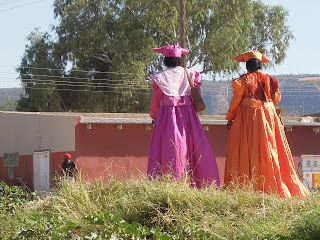
Herero women wore brightly coloured Victorian-style dresses with a matching head piece in the shape of a bull’s horn.

The Himba women wore cow-skin skirts and were the same ochre colour as the dust under their feet. Their hair was dreaded but caked in clay and their bodies were adorned with extravagant heavy iron and leather jewellery.

Then there were the Themba women who wore cotton skirts and layers of jewellery around their waists, necks, ankles and arms, but theirs was made of brightly coloured beads.

Harald dropped us at the cheapest lodge in town which for a clay hut with nothing but two single beds and some torn up mosquito nets it was over-priced but we didn’t care at that stage, we wanted to hit the streets.

The town was bustling as it neared dusk. It was dirty and dusty and the edges of the road were lined with rubbish – mostly empty beer bottles. The brick houses that were actually shops or bars were old and run-down, and the make-shift tin shacks looked like they were only ever intended to be temporary.

But I loved it. I loved how gritty it was. I loved how raw the people were. I loved the energy. I LOVED that Africans did their business on the streets, not behind closed doors - it makes far more entertaining tourism.

Opuwo is quite small. It had a market place that had already closed up for the day, a bakery, a supermarket, a few banks and one café. It had plenty of bars though. And none of them seemed to be wanting for business.

We got stared at the whole time… of course! But we were staring back just as intensely. Many people came up to us, and spoke to us, but very few spoke English. It was hard to know at that stage if the greetings were friendly or hostile.

We stopped in front of a very large brick bar, full of people. Squatting against a wall was a group of a dozen Herero women, in their beautiful bright robes plonked down on the dusty ground in a pile of empty beer bottles. We watched in awe, as they passed around bottles of beer, belched and wiped the snot from their face with the sleave of their elegant satin robes. The sight was so contradictory it was exceptionally peculiar.

I suggested to Chris we have a beer at the bar. He hesitated, as I wanted to, but I forced myself forward. Every eye in the place followed us all the way to the bar and then all the way back out the door again to the outside where we perched on the step to devour our beer, and the best view in town.

Within seconds an old Herero woman in a bright yellow dress stumbled up to us and leant down to rest her elbows on my shoulders. In my ear she slurred something in words I didn’t understand. Her eyes couldn’t find a focus and she reeked of alcohol, but she was in a damn good mood and her toothless smile spread ear to ear.

She indicated that she wanted us to move over and she fell down between Chris and I.
Her head lolled from side to side and occasionally she stretched her arms out in front of her face and waved them around like she was dancing.

Shortly after we were surrounded by a swarm of drunken women. They all started running their fingers through my hair, poking at me and grabbing my beer to swig from it. It was hard to see who was playing with Chris, I was literally trapped in the circle of women. They all talked at once and then pulled me up and over to the dance floor.

I kind of awkwardly shuffled along with the girls and tried to imitate their dancing style. They stuck their bums out and shook it, while they held their elbows up and out to the side. It is a very bum-heavy dance that I was not used to and I felt a great sense of relief when Chris appeared at my side, shaking his arse to the beat. The girls loved it and I am believed their laughter was in good jest. The dance floor attracted a very entertained crowd.

Then this girl staggered up to me, she was so drunk I was impressed that she managed to stay reasonably vertical. She started grinding up against me, touching my breasts and my face and she wedged her thigh between my legs. I kept backing away until I hit the wall. I sent Chris ‘help me eyes’ but he shrugged in a ‘what the hell could I do’ kind of way.

I was too careful not to be rude. I didn’t yet know what was and wasn’t culturally appropriate, but I wanted her to back off.

Finally one of the girls that had pulled me to the dance floor marched over and pulled her off me. But that didn’t go down too well and a fight broke out.

The full-on drunk girl’s friend stomped over and started yelling and then four more girls appeared and the fight was on. Chris and I stood there helpless and dumbfounded. It would have helped if we knew what they were saying.

The girl who had first saved me grabbed me by the arm and yanked me out of there. Chris shuffled close behind. Her name was Elsie and her English was quite good. Her posse followed us to the next bar a few doors down.

It didn’t take long for the drunk girl to hunt us down again, this time she wrapped her arms around my neck and pressed her body against me “don’t you want me?” she slurred in my ear.

“What the hell was happening here?”

 I was so confused at that stage. If a girl did that to me in Sydney I would have had an inkling into what it was she wanted… but in the farthest reach of Northern Namibia could this girl actually be gay?... And open about it! Or was it simply a matter of confused cross-cultural communication and language barriers?

I wriggled free and told her she needed to go home and sleep. Chris just stood there and laughed as she tried to embrace me again.

Again Elsie came to my rescue and heaved her off me. This caused an even bigger fight. It was mostly verbal except for a few pushes and shoves.

Elsie and her friends won the fight again and the drunk girl and her friends sulked off. Mostly I was afraid that they all knew I was gay then, and afraid of any repercussions it could bring.

We all move on to the next bar and I bought Elsie and her friends a beer for saving me. They dragged me up to the dance floor again and yet again a crowd of gawkers gathered around. Chris and I must have been a sight though. The girls did their best to make my awkward body bounce around like theirs.

Another horribly trashed woman stormed up to Chris and demanded money. He said “no sorry” and she stepped over to me and in the same aggressive growl she demanded money. She poked a finger between my eyes and I stared back at her and said nothing. For a third time that night poor Elsie came to my rescue and for a third time that night she got into a fight doing so.

I was over it then, exhausted and overwhelmed. Elsie suggested we go to another bar, I suggested we went home.

As we left I saw the drunk girl number 1 watching me (the sleazy one) and I knew that leaving was the right decision.

We all headed out of there together and were walking down the street when Elsie yelled “police!” She grabbed Chris’ bottle of beer from his hands and hid it under her animal-fur mid-riff jacket.

The paddy wagon pulled up and three cops in camouflage crawled out. I couldn’t understand the words but it was plain to see that the cops were not happy with Elsie and her bottle of beer. She tried to object and all of her friends were protesting flustered. One of the cops walked around to the back of the car to open the wagon door. In Australia it is a fairly empty threat, but I could see the panic rise in the girls and I got fearful for them.

I stepped up and grabbed the beer from Elsie and emptied its contents out.

“It was my beer” I told the cops. “I am sorry I didn’t know the rules, she is my friend, she was just helping me… see no more beer, my mistake”

The main cop stared me down, he stared at the girls and back at the other cops. There was silence as we all waited with held breath. Finally they all got back in their car and drove off.

We kept on walking and I saw that Elsie was literally shaking, her teeth were even chattering. She didn’t even get slightly scared in the other three fights she faced that evening and I only just realised what a close call it had been. Perhaps in Opuwo the cops didn’t just parade around in pathetic attempts to look macho like they did in Australia, maybe in Namibia their threats were real.

Back in the silent hut I exhaled fully for the first time since getting dropped off in Opuwo. No more watchful eyes on me, no more dodging drunken bodies, no more people sticking their open palm out in my face demanding money… at least not for another 8 hours anyway.


That pile of beer was where the Herero women were sitting
two herero women


A himba family

Tuesday, 30 October 2012

Hitching North


Chris had claimed that he was a magnet for good luck. I defended the belief that I too had attracted a lot of good luck on this trip. What I learnt within the first hour of travelling with Chris, was that when we took his good luck and added it to my good luck, we would have a phenomenal amount of good luck.

The plans we had made to get out of Windhoek were as complex as ‘find main road, stand on side of road with hand out, get ride going north’. We thought if we made it the 250km  to Otjuwarongo we would be doing alright, though we dreamed of making it as far as Outjo, an extra 100km north of that. Namibia is one of the least densely populated countries in the world, and it was not yet tourist season (though tourists are renowned for ignoring hitch-hikers anyway) so we were realistic enough to be prepared to spend most of the day, and the next few days after that, standing on cramped legs in the sweltering sun in the exact same spot, probably feeling defeated.

My walking shoes had been stolen the day before and my back pack and I had just one thing in common – we were both steadily gaining a couple of kilos each week. This had only become a problem because the main highway north was 5km away, and it was already over 30 degrees.  Before we had even reached the 1km mark of our 5km walk, Chris decided he needed to stop at a petrol station to buy a soft drink. I waited outside only to be approached by a young white guy who asked where I was headed. I pointed out Chris and told him we were heading north and he said that he can drive us as far as Outjo.

I was dumb-founded! We barely had to do any work to get this lift and he wanted to drop us exactly where we had dreamed of getting to!

I wondered, was it Chris’s luck for having to stop right then and there to get a drink, or my luck for standing in the right spot outside and having an angelic (or just sweaty and tired) enough look to attract a sympathetic offer? I did also wonder if it weren’t too good to be true… was he going to beat and enslave us and make us work at gun-point in Namibia’s infamous diamond mines?

Our driver’s name was Daniel, and before we could hit the highway he had to make a few stops. One of the stops was at his large three story house where we sat on the veranda drinking tea while he showed us his Nazi magazines and books from pre WWII, now illegal in Germany, but a collector’s item. He bragged about his gun collection. His pregnant wife was in her room and would occasionally yell out to him, to attend to her for some reason or other – we never actually saw her.

We also stopped at his business which was in the process of being closed down and cleaned out. It was a computer/game place in the shopping mall which, as he explained, was designed to give local kids something to do other than drugs and trouble-making. Apparently a party there one day got out of control and so the mall closed him down, Daniel said that whilst he was trying to do right by the community, the owners of the mall did nothing but screw him over. Daniel had lots of stories like that – about him trying to save people with his grand ideas while big businesses and the people kept screwing him over.

He told us how he had approached car manufacturers in Germany because he had designed a car that ran on air pressure. He had also approached the Namibian government because he had figured out a way to power the entire country by burning wood chips (not that that sounded at all sustainable to me) and apparently he had also had meetings with the big banks… he had single-handedly figured out a way to solve the countries economic problems.

However no one wanted to buy his inventions or implement his strategies… “the whole country is run by idiots” he tells us. I’m sure he was right about that at least – most countries are run by idiots, but I was starting to worry about Daniel, and the fact that I was sitting in the front seat beside him and had to hear these stories for the next 4 hours or more, while Chris sat in the backseat pretending to sleep.

He also talked about Namibia. He is from Germany but moved to Namibia when he was 18 (ten years ago), his parents own a safari lodge in Outjo, though they still live in Germany so they hired full time staff to take care of it. He said Namibia is the place to go if you need to “disappear off the grid”, he said there a lot of white people here in exile from other countries, and they’re either running away or fresh out of prison. He told us about his friend that worked for the German intelligence, that he let it slip  that the German government knew 9/11 was going to happen before the disaster occurred, and now both the US and German government were after him so he’s hiding in Namibia.

He talked about the staff on his fathers lodge. The managers are white Germans and the rest of the staff are black locals. When his father took over the lodge he built the staff proper houses for them and their families to live. He said they get paid very little, but they get given their food and health insurance and that if they didn’t do that “they would drink all their pay away and their families would starve”. It is hard to know what is blatantly ignorant racism and what is the unfortunate and ugly truth.

We stopped at a small village along the way so Daniel could visit one of his friends. The village reminded me of those in Ghana. People loitering (read: beer drinking) out the front of small tin shacks, children running barefoot, chickens pecking at the feet of jittery goats, music blaring, people trying to pull us over to talk, and sleazy men asking me for my contact details and giving me that hand shake eluding to sex: when they wiggle the tip of their index finger against the palm of your hand – that always grosses me out!

The friends in the village Daniel had stopped to see were in the middle of building their house. A house made of brick, with two bedrooms, a kitchen and separate lounge room and a fenced off garden. A house that once finished will bring them a sense of prestige and will no doubt be the envy of the village. Some of what Africans have adopted from their colonisers is outlandish. Traditionally, African’s have congregated outdoors; they eat, bathe, socialize and dance outside on the streets, it isn’t like Europe where the weather is so intimidating you need to stay inside. It is yet another commodity introduced by whites that is bigger and ‘better’ and reeks of false displays of superiority and yet now, here in this little Namibian village of tin shacks, stands one big oddball house, which its proud owners obviously feel they need… But then again, maybe they do? Who am I to make judgements on what people in Africa do and don’t need?!

Daniel drove his Alfa Romeo at 180km/hr (60km above the legal speed limit) and talked non-stop. We got to Outjo and he kept driving. He seemed to assume, without asking, that we would stay at his parent’s safari lodge.

We arrived at Sophienhof Lodge… and it was beautiful But it looked expensive.

Chris was the first to ask how much it costs. A dorm room was usually 200 Namibian dollars ($20 AUD) a night – that was twice our budget. Daniel shrugged and said he didn’t mind, he would make it cheap for us.

He then asked if we wanted to go on a private game drive. Duh! Yeah!

One of the staff joined us and we headed off in an open safari car in search of animals – it was nearly sun-down and nearly feeding time.

We got out to feed the ostriches pellets. They strutted up to us (at a speed over 50km an hour!) and snapped them right out of our hands with their strong, sharp looking beaks. Every time one made a sudden movement I shrieked like a little girl.

The next stop was to feed the cheetahs. They were rescued cheetahs but caged none the less and although it was poignant spending those sunset hours up close to three beautiful cheetahs, it was sad to see them captive, regardless of how big the cage was (it was big enough to not be able to see the surrounding electric fences).

On the safari drive we saw warthogs, zebra, wildebeest, springbok and the majestic kudu.

After the drive I was starving and wondered how we’d go about finding food. We seemed to be the only guests at the lodge except for a family of campers that had their own supplies and cooking equipment. I wondered if it would be rude to ask Daniel to drive us in to town.

But Daniel led us to the outdoor dining room, and shortly after the manager appeared with zebra and lamb steaks, rice, salad and of course beer. Chris and I devoured our meal, as well as seconds, and we continued to listen to Daniel’s stories. All around us was pitch blackness and the eerie sounds of unfamiliar bush lands.

In the morning we woke to be greeted by breakfast – eggs, cold meats and toast, tea, coffee and juice. We were living the life! Chris and I were feeling giddy – high on the realisation of our luck. Daniel invited us to stay another night and of course we could not decline.

Sophienhof Lodge had beautiful green manicured lawns and a swimming pool. Daniel showed us the entire property including the managers hut built in 1904, with walls covered in the heads of prized animals. At sunset we sat in relative quiet rocking in chairs on the veranda of the ‘honeymoon cabin’ which overlooked the distant mountain ranges.

We were served dinner again that night and again the next day we woke to breakfast.

I told Chris that it was my dream to own and live and work on a lodge similar to this. In the Australian bush though, where I would grow my own food and rent out holiday cabins nestled alone in the corners of the property. For those two days at Sophienhof Lodge I felt like I was living in my dream.

Daniel only charged us 200 Namibian dollars each for both nights – that included all the food and game drives and he did get us this far north as well. Daniel may be a bit of a tool, but he is a generous guy that’s for sure. And he showed us a hell of a good time.

Daniel dropped us into town and I had to get cream for some spider bites which were irritating as hell (probably should have mentioned those in an earlier blog, as they stuck around for days) and we wanted to buy Daniel a thank you present. Part of his present was some biltong. Biltong is dried, salty meat that is hugely popular in Southern Africa and Daniel loved the stuff. I got to the butchers right before it was about to close but the owner (white) invited me in anyway and we had a lovely chat. As I was leaving a black woman came in and the owner, no longer so friendly, abruptly told her he was closed.

I stood there awkwardly stunned and uncomfortable. Was I really the absolute last customer or would he have let her in anyway if she was white? It was a situation where I couldn’t be sure. Maybe he had already done a favour and let me in and that was where he drew the line and I was just being super sensitive and paranoid… or maybe I was let in because I was white.

I didn’t know what to say and she left before I said a single word.


Thursday, 25 October 2012

Shoe-less


The next morning I woke up after 13 hours sleep! I can’t be sure if I was just catching up from all the sleepless nights beside snoring Alex (including one especially sleepless, especially uncomfortable, night in the car trying to get away from his snoring!), or if I just slept so much because I had nothing else to do.

After jumping out and leaving the boys behind I  paid a ridiculously large amount of money for a single bed with a sagging mattress in a dorm that I had all to myself, in a hostel that had no other guests and a restaurant that was permanently closed, in a town that had nothing but a queue to get dole payments and a lot of beggars that didn’t look particularly nice. At least I was free again to make my own decisions.

It poured down with rain that night so I couldn’t walk the streets like I usually do to kill time. I’d had two beers so I couldn’t read, there was no communal room with a television in the hotel and no other guests to talk to. So at 6pm I had nothing else to do but go to sleep.

Right before I was about to hit the sack there was a knock at the door. The lady at reception was worried about me. She wanted to know why I was travelling alone, where I was going next and whether or not my husband and children were worried for me. She couldn’t believe I survived Ghana, but that disbelief was overshadowed by the mere fact that I would go anywhere alone. There was no way she was letting me hitch to Windhoek the next day, so she called a bus-driving friend of hers to collect me in the morning and take me there.

In the morning I sat alone in the foyer eating a mini bowl of cornflakes while I waited for my bus to arrive. I was dead-certain that the man working there was gay. He was excited that I came from Australia – McLeod’s Daughters was his favourite TV show, and his dream was to work on a cruise ship boat and travel the world…. I hopethat one day he gets that job – everyone deserves a dream.

He asked me if I liked Namibia, I told him the landscape was stunning but that I found Namibians hard to talk to. He told me that Namibians were shy people and generally afraid of foreigners…. White foreigners.

As if to prove his point a delivery man showed up two minutes later and thought I worked there. I told him I didn’t but pointed to the door that lead to reception. He kept apologising profusely, keeping his eyes down at all times. Then he couldn’t open the door to reception so I got up and opened it for him. He practically bowed in half, kept his eyes down and continued to apologise incessantly.

It felt good to be back on local transport again, all over Africa the mini buses are much the same. First you sit in the one spot waiting for the bus to fill its seats before it can depart. It finally fills up and you think ‘great it’s going to leave now!’, but it never does. It sits there and waits until more and more bodies pile on and cram into spaces where there is no space. Like a game of Tetris people bend and fold around each other, squeezing there boxes and baskets onto other peoples laps and under butts, until there is not enough air to share and the bus finally takes off.

After sitting at the bus stop for an hour or more they always drive for only five minutes before stopping for petrol. They roll one side of the car up on to a pile of bricks and a group of men bounce on the side of the car trying to fit every last drop of petrol in the tank while the tightly folded passengers with no air start to feel nauseous from all the bouncing.

The heat inside swells and bodies steam a pungent odour while bad American pop- music blares from the speakers and all the passengers stare at the only white person on the bus…. I had missed this!

In case you were wondering which bad American music was playing, one song which played 7 times on that trip went like this:

“Can I be your number one man killer? Of course you can be my number one man killer!”

And that line was repeated over and over and over and over and over and over and over….

At Windhoek I checked into the backpackers that offered free internet. But first I had to make sure Alex and Michael were not booked in there too. The lady at the desk scanned her book and assured me that they were not.

When I went to bed that night guess who crawled into the bunks beside me? … Alex and Michael!

 I cursed the universe for trying to teach me a lesson the hard way. But I decided to take on that lesson and apologise to Michael and assure Alex that he was not the reason I jumped ship.

I told the staff I was checking out, and after breakfast I went to grab my bags. The whole room had been cleaned, my backpack was sitting there waiting for me but my shoes were gone. I only had one pair of shoes, they were my brand new Solomon hiking boots and I had left them at the foot of my bed but now they were gone.

I asked the woman at reception if she knew where my shoes were. She allowed me to search all the cupboards in the place but I couldn’t find my shoes anywhere. I asked her if the person who cleaned my room was still there so that I could ask if my shoes were at least spotted, then I may know if it was another guest or the cleaner who took them. She said that no, the cleaning lady had already left for the day and wouldn’t be back until 7am the next day. I asked if she could call the cleaner to ask if she had seen my shoes. She said that no, the cleaner does not have a phone.

I left a little frazzled and checked in to another hostel – a cleaner, quieter hostel with no Michael in it. The next morning I got up and walked back to the hostel to find my shoes. The same receptionist was quite surprised to see me there, I think she thought I had not just been checking out of the hostel, but checking out of Windhoek too.

Of course she still hadn’t seen my shoes.

“Well what about the cleaning lady, she is here today, may I ask her?”

“No, she is on holiday for a week”

“But yesterday you told me she was back today”

“No I didn’t”

“Yes you did”

“NO she is away…. But I called her last night and she said she did not see your shoes”

“But last night you said she doesn’t have a phone!”

“No… the other cleaner doesn’t have a phone, the one on yesterday does”

“WHAT?! When was another cleaner mentioned? That doesn’t make sense….”

A hostile stare from the receptionist and I knew I would never see my shoes again.

I couldn’t afford new shoes at this stage of my trip, so I knew that I would have to wear thongs for the last 6 weeks of the trip. It also meant I couldn’t hike the Simiens in Ethiopia. But it was the first thing to go missing in the 2 months I had already been travelling, and at least it wasn’t my passport or camera.

As I was walking back to my new hostel, from my old hostel I hear footsteps running up behind me. A young woman, I’ll guess 20 years old, catches up to me and when I turn she gasps “oh! I thought you were a man!” She takes my hand in hers. I HATE holding hands with strangers! But I was too polite to pull away so we walked awkwardly down the street hand in hand.

I keep my eyes fixed to the ground in front of me. She keeps her eyes fixed on me. So much so that she nearly trips twice.

She asks where my boyfriend is.

She tells me she is on her way to KFC, that her boyfriend is meeting her there in half an hour to buy her chicken, but that she is hungry now and can’t wait for him. I tell her I don’t have any money. We get to KFC and I try to pull my hand free and say goodbye, but she clasps it tighter. She insists on walking me to my hotel. I politely decline the offer. She squeezes my hand so tight that I can feel it turning purple.

With an aggressive jerk of my arm and twist of my hand I pull free. She steps even closer and I grab her shoulder and hold her at a distance – not roughly, but strongly. She glares at me and I have no doubt now that it is a stand-off. She was definitely threatening me but I stood my ground.  She tried to grab me and I squeezed her shoulder harder. She winced and I knew that I was stronger than her. I stared in to her eyes, firmly said goodbye and walked away… She didn’t follow me.

I had been having second thoughts about hitching north with Chris. My experience with Michael and Alex had turned me off travelling with strangers. I was craving something more rustic, something more challenging… I was ready to head north-east to Ethiopia.

When Chris arrived that night, exhausted from hitching up from the south, I changed my mind again. Firstly because he had changed all of his plans to come and meet me, but secondly because I was reminded of his gentle nature and zest for life.

He shared inspiring experiences and retold touching encounters with the people who’d driven him this far.

I thought ‘this could be good…. This could be great! Hitching north, into the unknown, looking for tribes I have only vaguely heard about… this sort of adventure was what I went to Africa to do after all’.

I was starting to feel the niggly effects of travelling. The exhaustion had just started creeping in and thoughts of home were close to becoming a craving for home. But I told myself that I had to push on. Keep going. Keep exploring. Don’t give up yet.